


We all experience emotions from an early age. As adults attempting to navigate the often chaotic world of modern life, the range of emotions we experience in a day can change dramatically.
Our ability to feel and respond to our emotions is often taken for granted. We rarely stop to think and pay close attention to what we’re feeling. We do not consider the impact it has on our mental and physiological states, or the long-term implications holding onto emotions has, that might be harmful to us.
In this article, we’re taking a deep dive into emotions – specifically negative emotions – what causes them, the effects of them, and how we can use them to create a greater sense of wellbeing.
These science-based exercises will not only enhance your ability to understand and work with your negative emotions but will also give you the tools to foster the emotional intelligence of your clients, students, or employees.
What are Negative Emotions?
It’s important to distinguish between what an emotion is and what a feeling is. While the two are interconnected, there’s a bigger difference than you may realize. It’s definitely something that surprised me when I began with my research.
Emotions – Emotions are regarded as ‘lower level’ responses. They first occur in the subcortical areas of the brain such as the amygdala and the ventromedial prefrontal cortices. These areas are responsible for producing biochemical reactions that have a direct impact on your physical state.
Emotions are coded into our DNA and are thought to have developed as a way to help us respond quickly to different environmental threats, much like our ‘fight or flight’ response. The amygdala has also been shown to play a role in the release of neurotransmitters that are essential for memory, which is why emotional memories are often stronger and easier to recall.
Emotions have a stronger physical grounding than feelings meaning researchers find them easier to measure objectively through physical cues such as blood flow, heart rate, brain activity, facial expressions, and body language.
Feelings – Emotions are seen as preceding feelings, which tend to be our reactions to the different emotions we experience. Where emotions can have a more generalized experience across all humans, feelings are more subjective and are influenced by our personal experiences and interpretations of our world based on those experiences.
Feelings occur in the neocortical regions of the brain and are the next step in how we respond to our emotions as an individual. Because they are so subjective, they can’t be measured the way emotions can.
Psychologists have long explored the range of human emotions and their definitions. Eckman (1999) identified six initial basic emotions:
- Anger
- Disgust
- Fear
- Happiness
- Sadness
- Surprise
He later expanded on this to include a further eleven basic emotions:
- Amusement
- Contempt
- Contentment
- Embarrassment
- Excitement
- Guilt
- Pride
- Relief
- Satisfaction
- Sensory Pleasure
- Shame
Pam (2013) defines negative emotions “as an unpleasant or unhappy emotion which is evoked in individuals to express a negative effect towards an event or person.” Reading through the list of Eckman’s basic emotions, it’s quite easy to determine those that might be referred to as ‘negative’ emotions.
While we can use the label negative, with what we know about emotions, it’s important to acknowledge that all emotions are completely normal to experience. They are a part of our ingrained DNA. What is more important, is understanding when and why negative emotions might arise, and developing positive behaviors to address them.
A Look at the Psychology of Emotions
One of the more popular psychological theories of emotions is Robert Plutchik’s Wheel of Emotions. Plutchik (1980) stated that there are eight basic emotions: joy, trust, fear, surprise, sadness, anticipation, anger and disgust. Plutchik went further by pairing the emotions with their opposites and then creating the wheel of emotions, which serves to elaborate on how complex and interactive our emotions are.
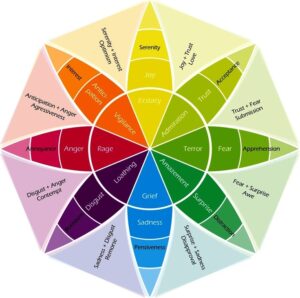
As mentioned, Plutchik paired the basic emotions with their polar opposites to help further develop his theory, so:
- Sadness is the opposite of Joy
- Anticipation is the opposite of Surprise
- Anger is the opposite of Fear
- Disgust is the opposite of Trust
Plutchik’s wheel is a strong visual representation of how our emotions present themselves. As you can see the core emotion decreases as you move outward on the wheel. Plutchik also used color to represent the intensity of the emotion: the darker the color, the more intense it is. So at its most intense trust becomes admiration, and at its least intense, acceptance.
It’s a fantastic starting resource for helping us further develop our understanding of how our emotions present themselves, how they fluctuate and how they can interact with each other. It has informed further psychological research in this area and is often the foundation on which researchers exploring emotions have based their research (Eckman, 1999, Parrott, 2001, Lazarus & Lazarus, 1996).
Shaver et al (1987) and later Parrott (2001) proposed a ‘tree’ of emotions that broke emotions into primary, secondary and tertiary dimensions. This includes 6 primary emotions (love, joy, surprise, anger, sadness, and fear), with associated emotions that develop at the secondary level, and again at the tertiary level. For example, if the primary emotion is joy, the secondary emotions could include cheerfulness, optimism, or enthrallment and the tertiary level could include pleasure, triumph, or hope.
Cambria, Livingstone, and Hussain (2011) took Plutchik’s wheel to another level and developed ‘The Hourglass of Emotions’. In their book, they built on Plutchik’s eight basic emotions and broke them down into four dimensions: sensitivity, attention, pleasantness, and aptitude. They also made distinctions between which of the emotions were positive (joy, trust, anger, and anticipation) or negative (disgust, sadness, fear, and surprise).
Research and Studies
The more research has tried to understand our emotions, the more that’s come to light around the distinction between positive and negative emotions, and the impact of each on not only our mental wellbeing but our physical well-being too.
Below I’ve collated a few summaries of the studies I found while researching this topic that will hopefully give you a bit more insight into our current understanding of negative emotions:
- Schwarz and Clore (1996) developed a theory of ‘feelings-as-information’ which conceptualized the role of our emotions in how we make judgments about our environment. They theorized that our emotions provide us with feedback on the safety of our environment and our capacity to handle given situations. In this respect, negative emotions provide us with the strongest indication that something is not right, or that our safety might be compromised.
- Anxiety is often seen as a negative emotion, but it’s a necessary one to spur us to action. We often find it difficult to respond to situations without the presence of this emotion but it’s important to keep it in check as prolonged anxiety can impair our cognitive functioning (Rosen, 2008).
- Adler, Rosen, and Silverstein (1998) explored the impact of negative emotions in the role of negotiation. Focusing on two negative emotions – fear and anger – they found that negotiators who couldn’t control or understand these emotions when they arose were often unable to mediate the situation effectively, despite their training. Similar research has explored the ways different emotions, such as anger and gratitude, impact cognition and behavior within the context of mediation (Williams and Hinshaw, 2018).
- Biswas-Diener and Kashdan (2014) wrote an entire book on the positive motivation that negative emotions can move us towards. They see negative emotions as motivators to help us address and correct behavior and take action.
- Negative emotions have also been studied in cultural contexts. Rozin et al. (1999) explored feelings of contempt, anger and disgust, and their impact within American and Japanese communities on moral codes such as community, autonomy, and divinity.
- Appraisal Theory has also taken a look at negative emotions – specifically anger. Studies have found that people feel angry when they view an event or situation as personally relevant to them, inconsistent with what they are trying to achieve, and when this is caused intentionally by another person. Appraisal theorists emphasize the role of perception of potential threats (Lazarus, 1991, Roseman, 1991, Smith and Elsworth, 1985).
Anger, frustration, fear, and other “negative emotions” are all part of the human experience. They can all lead to stress and are often seen as emotions to be avoided, and ignored, but they can actually be healthy to experience. A better approach is to manage them without denying them, and there are several reasons for this.
Managing Negative Emotions
The idea of “managing” negative emotions is a complex one. It doesn’t mean avoiding them. It also doesn’t mean letting these negative emotions wreak havoc on your life, your relationships, and your stress levels. Unmanaged anger, for example, can compel us to destroy relationships if we allow it to.
Managing negative emotions is more about embracing the fact that we are feeling them, determining why we are feeling this way, and allowing ourselves to receive the messages that they are sending us before we release them and move forward.
This statement may sound a little odd, but our emotions are definitely designed to be messengers to tell us something. These messages can be very valuable if we listen.
Managing negative emotions also means not allowing them to overrun us. We can keep them under control without denying that we are feeling them.
Why is it important to manage recurrent negative emotions as these are one of the root causes of non-communicable diseases?
How Do Negative Emotions Affect Us?
Anger, fear, resentment, frustration, and anxiety are negative emotional states that many people experience regularly but try to avoid. And this is understandable—they are designed to make us uncomfortable.
Negative Emotions Can Cause Stress
These negative emotional states can create extra stress in your body and your mind. This is uncomfortable but also can lead to health issues if the stress becomes chronic or overwhelming.
Nobody likes to feel uncomfortable, so it is natural to want to escape these feelings, and the dangers of unmanaged stress are real. However, there is a feeling that people sometimes have that these emotions will last forever or that the feelings themselves are the problem.
Negative Emotions Also Provide Information
More often, these feelings are beneficial because they can also send us messages. For example:
- Anger and anxiety show that something needs to change and that perhaps our well-being has been threatened.
- Fear is an appeal to increase your level of safety.
- Frustration or resentment motivates us to change something in a relationship.
Basically, negative emotions are there to alert us that something needs to change and to motivate us to make that change.
Techniques for Managing Negative Emotions
The field of positive psychology is experiencing a “second wave” of research that is focused not only on what makes us happy, resilient, and able to thrive but also on the dark side of happiness. Experts have learned more about how our negative emotions affect us and what to do with them, and how we can remain emotionally healthy throughout the process.
Just as there are benefits to negative emotions, there are detriments to “false positivity” where we shame ourselves for experiencing these natural states and try to deny them or force ourselves to pretend we feel more positive than we do.
Self-awareness about negative emotions, Why is it occur and how is it impacting the body is a very good way of managing emotions.
The second way is to accept and even embrace our negative states. Acceptance of situations and persons immediately change our state of mind and changes our emotional state from negative to positive.
Another way of managing is the visualization technique, it basically involves envisioning your life in the future and challenging yourself to imagine the best possible life you can live, the best possible version of yourself that you can be.
Research has shown that people who engage in envisioning their best self for five minutes a day for two weeks experience a more positive mood and an increase in optimism compared to people who spent the same amount of time simply thinking about activities in their day. For five minutes a day, this is a great use of time.
A growing body of research suggests that having a positive outlook can benefit your physical health. Research has found a link between an upbeat mental state and improved health, including lower blood pressure, reduced risk for heart disease, healthier weight, better blood sugar levels, and longer life.
By using brain imaging, researchers have found that positive emotions can trigger “reward” pathways located deep within the brain, including in an area known as the ventral striatum. “Individuals who are able to savor positive emotions have lasting activation in the ventral striatum,”
Continued activation of this part of the brain has been linked to healthful changes in the body, including lower levels of a stress hormone. Negative emotions, in contrast, can activate a brain region known as the amygdala, which plays a role in fear and anxiety.